
Suggested Readings • [« Prev | Next »]
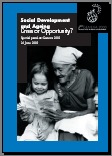
» Social Development and Ageing: Crisis or Opportunity?  • 2000
This brochure has been produced by the World Health Organization in co-operation with HelpAge International, the International Labour Organization, the International Social Security Association, and the World Bank on the occasion of the panel on Ageing and Social Development held during the Geneva 2000 Forum, the Next Step and Social Development, 26- 30 June 2000.
Contents: Population ageing is a neglected issue in social development • Ageing is not a crisis • Demographic ageing: The mythical time bomb
Read more: http://www.who.int/entity/ageing/publications/development/alc_social_development.pdf
Kinsella K & Velkoff VA, U.S. Census Bureau, Series P95/01-1. U.S. Government Printing Office, Washington, DC, 2001.
Population aging represents, in one sense, a human success story; societies now have the luxury of aging. However, the steady, sustained growth of elderly populations also poses myriad challenges to policymakers in many societies. After the year 2010, the numbers and proportions of elderly, especially the oldest old, will rise rapidly in most developed and many developing countries.
Read more: http://www.census.gov/prod/2001pubs/p95%2D01%2D1.pdf (3.9MB)
» Rate of Global Aging Increasing
usgovinfo.about.com
• 2001
Every month, the world's population of persons age 65 and older grows by 800,000 individuals according to a report by the U.S. Census Bureau and the National Institute on Aging (NIA).
In An Aging World: 2001, researchers report that developing countries tend to age faster than established ones. Demographers estimated that more than three-quarters of the world's net gain of older people from 1999 to 2000 occurred in still-developing countries.
Read more: http://usgovinfo.about.com/library/weekly/aa121701a.htm
» Global Aging: An Economic, Health, and Security Concern
www.state.gov • 2007
In many parts of the world, people are living longer and healthier lives. For the first time in history, people 65 years old and over will soon outnumber children under age 5. But this crowning achievement of the 20th century also poses significant challenges. As the world's population ages, the prevalence of chronic disease increases. Insurance, pensions, and other social support systems are strained. Many governments, both in the developed and developing worlds, are beginning to recognize that global aging can affect economic growth, labor force, trade, migration, international relations, and national security. To catalyze greater international dialogue on these challenges, the U.S. Department of State is hosting a half-day Summit on Global Aging, March 15, 2007, in Washington, DC. Members of the international community will be invited to attend.
Read more: http://www.state.gov/g/oes/rls/fs/2007/80940.htm
» Global Action on Aging: This Week's Focus
www.globalaging.org • 2007
As the health system in the US cuts health care spending, long-term care and geriatricians are the first to go. The problem of shortage of geriatricians is in part due to budget cuts and insurers refusing to cover geriatric care, but also because it is considered an unappealing profession. Most of medicine is about curing diseases and illnesses and helping people live and concentrate on youthfulness, whereas geriatricians have the unpleasant job of dealing with death and the failings of our bodies. They treat the elderly by helping them live independently and comfortably for as long as they can. The expected life span does not necessarily increase, but the focus on disabilities and other illnesses helps improve the twilight years. In an aging society that still idolizes youth, we have to learn to accept the limitations of our aging if we are to lead comfortable lives.
Read more: http://www.globalaging.org/index.htm